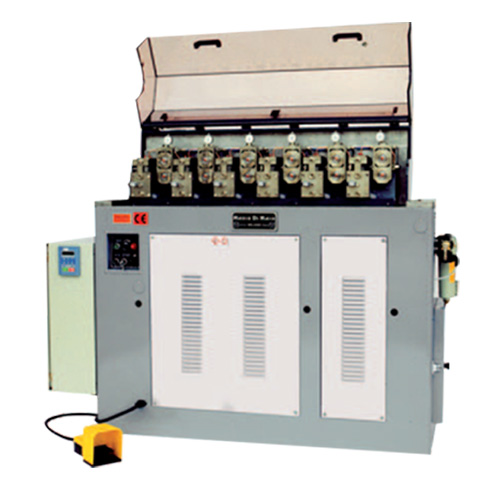
Continuous wire rolling is carried out with rolling trains, consisting of a series of rolling heads with in-line rollers, with progressively reduced rolling grooves that avoid the unevenness and difficulties deriving from traditional rolling mills with multiple-groove cylinders.
Usually, metal wire rolling occurs with a square section, to maintain a certain guide to the wire, while in continuous rolling it is also possible to work with other section shapes, since the wire does not change position and direction during rolling.
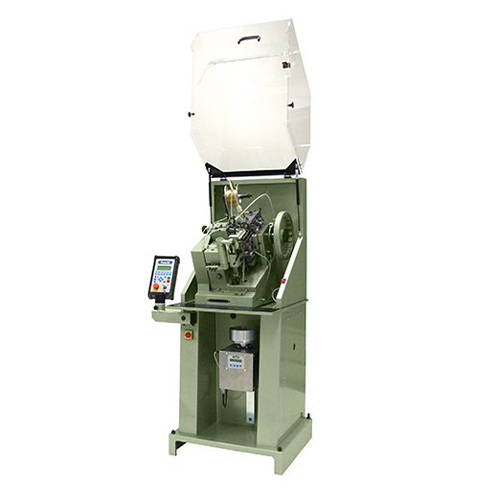
The wire rolling train is a conceptually simple and compact machine, which carries out the series of rolling operations automatically, thanks to a sophisticated mechanical construction and accurate electronic control of the working speeds.
The rolling trains are produced in three construction series, distinguished by the maximum rolling capacity of the incoming metal bar. The standard series accepts a maximum bar diameter of 7 mm, the Plus series 10 mm, the Maxi series 35 mm.
The choice of the number of passes of 6, 8, 12 or 16, depends on the processing needs of the metal wire, based on the maximum reduction and any intermediate annealing.
All rolling trains are equipped with variable speed from zero up to 40 m/min via digital inverter and can be coupled to create reduction sequences without discontinuity.







Reviews
There are no reviews yet.